
In February, the UK government published new guidelines on ventilation and air quality in education settings to improve student performance, and to reduce viral spread and absenteeism.
Multiple investigations have shown the effect of air quality on performance, this includes a Harvard School of Public Health study showing a significant increases in response time and reductions in accuracy at increased PM2.5 and CO2 levels for both office workers and students.
This follows similar moves from national and state governments around the world, including the EU, Japan, Canada, Australia and China. And in the US, comparable legislation is on the books in states spanning from California to Massachusetts.
And in many countries these regulations go beyond purely publicly owned infrastructure, for example New Zealand implements the Healthy Homes Standards, which sets minimum requirements for heating, insulation, draft stopping, moisture ingress and ventilation, with compliance a legal requirement. Similarly, Australia’s WELL building standard and NABERS has placed a formal emphasis on measurable indoor air quality outcomes, in part to also help reduce health effects from the recurring bushfire smoke events.
Heating, ventilation, and air conditioning already account for approximately 40% of all energy that a building consumes, and this will only increase if the fresh air needs to be heated or cooled. So, with education budgets already stretched tight, it will be vital to undertake ventilation cycles strategically rather than constantly.
IoT sensors already play a vital role in HVAC system efficiency through room monitoring to ensure heating or cooling is only undertaken when essential. This means keeping air refreshes localized to a single room where possible, and only refreshing the air when it is needed.
Air quality alarms, and smart HVAC systems with these air quality sensors integrated can therefore play a significant role in managing these costs. And as carbon dioxide is a strong correlative indicator for multiple airborne pollutants (including viruses) and these CO2 sensors need to play a key role in the creation of such air quality systems – be it for schools, hospitals or for commercial and private buildings.
IoT CO2 sensors
Arguably the core challenge facing the deployment of IoT air quality sensors is the delivery of power, especially in old buildings where power sockets may not always be available in the right location, with either battery-based systems or the integration of energy harvesters needed.
In addition to the CO2 sensor and battery, such IoT systems would need an MCU, wireless protocol (eg LoRaWAN/BLE) and/or a way to alert the user to take action (an e-paper display or light and alarm).
CO2 detection works by measuring NDIR spectral absorption at specific wavelengths, with CO2 absorbed at c.4.3 µm.
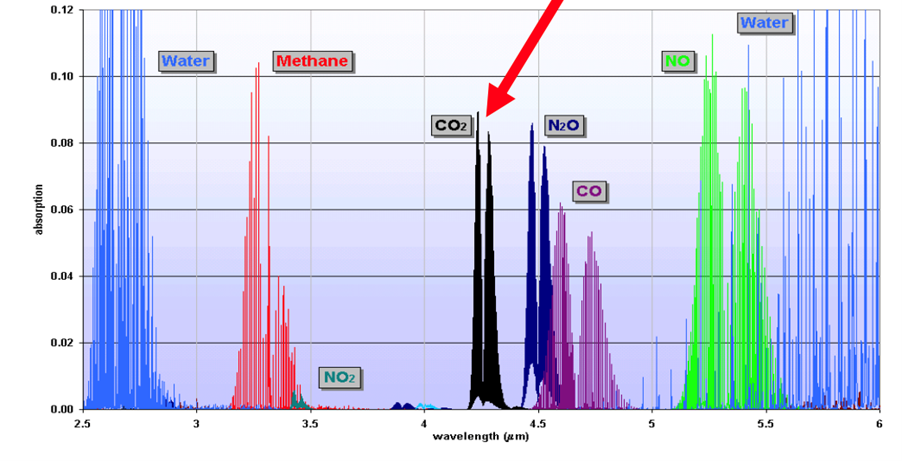
Figure 1: Absorption spectra for water, methane, NOx, carbon monoxide and CO2
And while sensors have now (mostly) shifted from the highly inefficient incandescent IR emitters to LEDs, traditional LED CO2 sensor architectures are still less power efficient than required for the rollout of battery/harvester systems – especially in large buildings with multiple sensors where someone would be needed to spend time regularly checking and undertaking battery replacements.
Indeed, with LEDs, the power consumption for a CO2 sensor is typically in the region of 50 to 150 mW average, with a peak of 300 to 400 mW.
An alternative sensor topology
The CozIR CO2 sensors from Gas Sensing take a different approach, one that is tailored to such applications with exceptionally tight power budgets, and one that has won awards for its efficiency in such applications.
The device implements highly-optimized signal processing algorithms and low-computational-load hardware to reduce the power required per duty cycle, with an ultra-low-power deep sleep mode and a configurable duty cycle that allows it to be set at a rate applicable to the application – which greatly reduces long-term power consumption to run only when required.
By applying these techniques, it’s possible for IR sensors to run below 1.5 mW with a peak of 33 mW. This enables sensors that are not just in the range that allows long-term operation from an AA or even a coin cell, but also in the range of even relatively small PV energy harvesters that allow permanent operation.

Figure 2: The Gas Sensing CozIR ultra-low-power NDIR CO2 enables IoT air quality sensors and alarms to run below1.5 mW with a peak of 33 mW
For more information on the CozIR family or any Gas Sensing Solutions device, please visit: https://www.gassensing.co.uk/